[ Book] ☆ New York Beauties Flying Geese: 10 Dramatic Quilts, 27 Pillows, 31 Block Patterns PDF by Carl Hentsch ↠ eBook or Kindle ePUB free
I am a fan of both Flying Geese and New York Beauties. The recent combinations of the two that have been cropping up on Instagram are very appealing. While I have about a thousand projects on my to do list, a block or two moved up higher when i saw the pillows on the front cover of this book. I can see myself trying one block and then getting into the what if cycle of creation, like I did on the Carpenter's Wheel.
Yes, I bought the book on impulse after seeing a review and some sample blocks on the Sew Sweetness blog.
Once I had the book in my hands I found it to primarily be a project book. The book has a one page, illustrated table of contents that focuses on the projects, but also includes brief sections called A Note from Tula, Introduction and The Basics. At the end there are sections called Block Index and Foundation-Pieced Arc Patterns.
A Note from Tula (pg.4) is an homage to Carl and his process, which differs from hers. The gem on this page is Carl has created quilts here that are aspirational. At a time when beginning quilters are becoming more confident and longtime quilters are indulging the desire to make quilts that take full advantage of their skills, here is a book that asks the maker to see more than boundaries and categories, to think beyond the visual choices, and to make something exception. (pg.4)
Carl writes the introduction (pg.6) and admits to loving paper piecing. I really like his idea of a book that would allow quiltmakers to create quilts that had standard building blocks - pieced arc, plain arcs, and fans - that could be mixed and matched in a variety of ways. (pg.6) In my opinion, this is the way all books should strive to written. This method helps the quiltmaker develop skills while creating something beautiful. Projects are great, but give people skills to move beyond the projects and soar into their own designs. Carl gives credit to Tula Pink for influencing his color sense and choices (pg.6). It is interesting to read Tula's note and Carl's ntroduction and note the different perspectives on the same process.
The first section in The Basics (pg.7-8) is all about choosing fabrics and thread. This is a short primer on choosing fabrics for your quilt. I didn't find this section be anything revolutionary. Mr. Hentsch freely admits to being a novice. He sticks to fabric lines or one designer - moving across fabric lines of that designer to add interest. If this section doesn't satisfy you, I would encourage you to look at the C& T Studio Color Wheel, the Ultimate 3-in1 Color Tool and Joen Wolfrom's ColorPlay and other books for more direction and ideas in the area of color.
Hentsch says, about thread, to stick with a single brand on any one quilt (pg.9), but he doesn't say why. I usually stick with one brand, but don't find this to be necessary in foundation piecing. Quilting, perhaps, but as long as the threads stand to the removal of papers, I don't see why it matters. When pronouncements like this one are made, I like to know the thinking behind it.
Making the Blocks(pg.10-17) is a primer on, well, as you probably guessed, making the blocks. Carl tells us the structure of the blocks (pg.10), how to cut shapes with templates (pg.11), as well as how to foundation piece (pg.13-16), curved piecing (pg.16-17) and how to applique' the center circles (pg.17). I always like to have a variety of choices when I am learning a new technique, so these are welcome.
If you just want to make a few blocks, the section on Finishing the Pillows (pg.18) will be of use. These directions are for filling the pillow with fiberfill rather than using a pillow form. You could modify the back to overlap and use a pillow form.
The projects start on page 19. The image on that page highlights Philip Jacobs fabrics so I can't but like the image. The projects follow. Each quilt project covers about four pages and includes the finished size for a quilt as well as a finished quarter block size. I find measurements to be useful and the more the better.
Each quilt project is followed by a pillow project which coordinates with the quilt before it.
I find reading about materials required in a quilt are always a challenge. I know the author wants to be clear about the materials s/he used for the quilt in the book. I also know that some quiltmakers want to take the materials list to the quilt store and use it as a shopping list. I find it difficult to think about my own fabric choices when an item on the list is listed as 'large scale black print' instead of 'background.' Still, Hentsch has done a relatively good job by listing colors and styles rather than specific fabrics in a certain line.
Carl does not tell the reader how to foundation piece in each patter, but refers back to the Block Indes (example pg. 22). Each quilt includes a colored drawing of the project (example pg.29), which can be helpful if the maker wants less interference in the selection of fabrics. Specific prints are not in evidence.
My favorite blocks are included int he Twin Dragons quilt (pg.32-35). The colors aren't for me, but the way the Flying Geese are in different places in each block quarter are very appealing. I like the slight feeling of chaos and the movement in this layout.
Each project also has a couple of paragraphs about the design or the fabric, which I enjoy (example pg.44). There isn't nearly enough process in books for me.
If I had seen the Seeing Spots (pg.50-53) project before cutting up my Ta Dots fat quarter pack, I would have used them for one of these quilts. Seeing Spots, with its Philip Jacobs background is cheerful and exuberant.
Sorbet (pg.60-63) has the blocks I like along with the cheerful exuberancy of the Seeing Spots quilt. I like the gradation/ color progression of Papyrus (pg.66-69). This quilts has the added bonus of including a variety of different blocks in it.
The Block Index follows the projects and includes seven pages (pg.76-83) of different quarter blocks the maker can combine into full blocks. I don't believe they are full sized, but the section makes no comment.
The section Foundation-Pieced Arc Patterns(pg.84-92) appear to be full sized. Again the author does not comment.
The final section Circle, Background and Plain Arc Patterns (pg.93-95) is much the same as the previous section.
My one wish is that this book would include an EQ7 CD or downloadable file. That was actually one of the first thoughts I had when I leafed through this book. While not everyone has EQ7 and it is possible to draw these blocks in EQ7, it would be a lot easier if they were already included. Picked up on a whim seeing flying geese in circular patterns, which I'd like to explore drafting - but this is a pattern book and not really a technique book. There are templates provided for foundation piecing and cutting from template plastic, but no instructions on how to modify sizes or push beyond the patterns presented. The author recommends using fabrics from related commercial lines or one designer, which I find very limiting - the quilts are beautiful (my favorite is Rust with fussy-cut octopus prints), but I'm not one for copying a design from a book. New York Beauties Flying Geese: 10 Dramatic Quilts, 27 Pillows, 31 Block Patterns Amazing, intricate quilts - probably too complex for me to ever make. :)
96
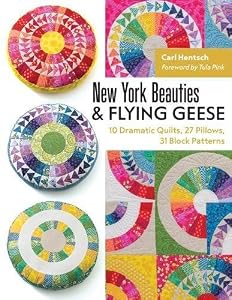
Become a skilled foundation piecer with New York Beauty blocks and arcs of Flying Geese that amaze! Stitch your way through 31 architectural block patterns, ideal for advanced beginners and intermediate quilters. Practice this straightforward approach to curved piecing, foundation piecing, and simple machine applique on 10 full-size quilts and 27 pillow projects. Lively color combinations provide movement and drama, with fabric selections from Tula Pink, in collaboration with Carl Hentsch. New York Beauties Flying Geese: 10 Dramatic Quilts, 27 Pillows, 31 Block Patterns
Comments
Post a Comment