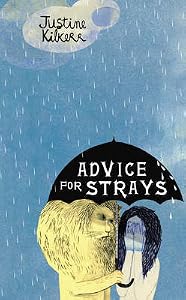
Marnie’s schizophrenic father has gone missing, again. But this is the longest he’s ever been gone and the pressure of the unknown weighs heavily upon Marnie’s mind. Her younger sister Jess’s response is to spend her days sitting on the sofa obsessively plucking out her eyelashes one by one; on top of that something ominous appears to have scared away all the neighbourhood cats, including Marnie’s loyal tom, Mr Knuckles, and Marnie herself, a copywriter, is plagued by insomnia and literally at a loss for words.
In the midst of the disorder, and of all the aid that could arrive, it is Jericho who returns to Marnie’s doorstep. Is he the playful imaginary companion of her childhood or the misanthropic, possibly homicidal, but undeniably real manifestation of her despair? Whatever he is, Jericho is angry. He doesn’t want to be here but in order to be free of the ties that bind him to Marnie, he has to find out what is wrong with her and fix it before irreparable damage is done.
An utterly original and hugely imaginative debut, ADVICE FOR STRAYS is a novel about love, loss and a very unusual friendship. Advice for Strays
This is one of the weirder books I've read. I found it depressing and a struggle to get through. I didn't like all the switching narrators and didn't like the main character either. Bit of a silly book choice for me!! English This is a strange book.
It's hard to know if I can say more than that without giving away the plot, if there is a plot. Or giving away what happens to the characters and what they do.
It is also a bit confusing because sometimes one does not know which character is speaking until one is halfway down the page, and then I have to go back to the top of the page and read it again with the other character in mind. But that's OK, because even the protagonist doesn't really know.
And also you sometimes don't know whether the events are taking place in the present or in the past. But that's OK too, because most of the time the protagonist doesn't seem to know that either.
Marnie and Jess Irving are twenty-something sisters whose father has disappeared. And in the neighbourhood where they live the cats are disappearing one by one. Marnie has a friend Shiuli and two other friends Dylan and Ruth. Sometimes they do things together but most times they dont.
It is about the ambiguities of friendship and love, about memory, love and revenge and the darkness that is within us.
I don't think I can say more than that without giving away the plot. If there is a plot. English I am someone who tends to ravish books from cover to cover in a gluttenous devouring orgy of literary hunger.
Every book in front of me is a meal. Every meal time feels like it is the first after a famine that lasted an eternity.
Which is why I wanted to change my eating habits when I recieved a copy of Justine's book.
Actually, that's not true.
I read the first eight chapters before UK postage stamp on the packaging hit the floor.
I stopped. I realised that this was an amazing book.
It was a literary dessert.
So, I started again.
I would only allow myself one chapter at a time.
I would only read one chapter after I completed my other tasks and duties.
I even employed a greasemonkey script to block out any mention of the book (especially reviews!) until I was done just so I can savour it without any influence!
So, it is has taken a while and I enjoyed every delicous word that tugged at my fierce heart.
The first chapter, the very first page struck struck me with an immediate impact. The words entered my mind and entwinded themselves around the strings of my heart and the loose ends of my mind.
Not since reading The Bell Jar, has an author grabbed my mind and had it walking around in a new skull. The strength of the words were immediate. Vice like in their hold. However, instead of crushing or restraining, there was a gentleness. It was a firm hug. It that stroked the nuerons to remind them that this was a journey they wanted to take. Take they did.
Each chapter was a short story in and of itself. Each was engrossing and filled me with mixed emotions. So difficult to explain the intertwining of sadness, festivity, loss, happiness, dreary reality, fairytale magic, dark fears and mesmerising hope.
There are so many subtexts that ride throughout each chapter and across the book. Whether it is the constant fear of loss - of her father, the family ties, the grip on reality, even her friendship - to the unspoken fear and facing the possibility of her own beautiful mind being afflicted with the same disease, the stories within stories, the unwritten words that sit between those that were already lovingly crafted, are just as powerful and delicious.
The words are amazing. There is a true depth of emotion that shines through like a tolling bell. A kurt-ness and style that I am convinced Vonnegut would approve of. A love for the magical and the hidden that the likes of Pratchett and Gaiman would appreciate. Finally, the twist of phrase and shining eye of absurdity that those of us who have had the pleasure to interact with her have come to appreciate is one of the most shining aspects of her being.
Justine has written a book that will forever be one of my top ten books to read and recommend.
Thank you for doing so. Paperback The words were carefully chosen and I often found myself re-reading passages just because of the way the words fit together. Reading this book was like a fine dining experience; it was delicious on so many levels.
Marnie's journey was lovely but also heart breaking. I wanted to read quickly in order to find out what happened next, but I also wanted to savour the reading. I'm glad I took my time.
My most favorite descriptive parts involved peripheral vision (page 209) and Marnie's memory (page 204).
This is a beautiful book. My review does not give it justice. I highly recommend this and am glad to know that Justine is working on a second book.
Fiction Beautiful. The thing that struck me the most about this book is how Justine is able to perfectly convey the atmosphereâ€"the sights, sounds, smell, the feelâ€"of a moment, thus succeeding in making the surreal as authentic as being there. In the hands of a less talented writer this wouldn't have worked, but Justine's skillful writing does it, and triumphs. She is the real deal.
Highly recommended. English
I started reading this last August, and only finished last month, taking the advice of other people who read this book to go slow with it. No, actually, what happened was school started, and the lack of forward momentum in the story compelled me to read only incrementally in the last few months. But for a 311 page book, that was still a long time.
Even so, once I finished the book I realized that I really liked it. It’s about a pleasant but anxious and slightly insecure woman named Marnie, who, when we meet her, is burdened with the stress of her schizophrenic father going missing. Before long, a lion named Jericho is introduced, who happens to Marnie’s imaginary friend from childhood, grown from an affectionate cub into a cynical king of the jungle (and yes, the question of whether or not Marnie herself is schizophrenic is also raised). Although primarily told in the first-person from Marnie’s perspective, the novel occassionally departs into narration from Jericho’s point-of-view, and the voices of both characters, especially Jericho, come through perfectly.
I mentioned that I was told to read the book slowly, and I’m glad I didâ€"it’s not a very plot-heavy story, but more of a meditative character piece. And despite the lack of narrative propulsion, we do traverse a lot of biographical and psychological ground, gleaning Marnie’s relationships with Jericho, her father, and various other characters in the process. And despite my comment about the “lack of narrative propulsion,†stuff does happen during the “present time,†but it’s informed, if subtly, by the stuff that happens before.
And damn near 100% of it is a joy to read, mostly because of how the novel’s simple language seems able to broadcast high-def imagery right into our heads. Whether she’s describing something exciting like fireworks, or something mundane like pulling rocks out of water, or something else entirely like a candlelit dinner, the beach at night, the onset of grief or anxiety, or lying with an imaginary (or is it?) lion in the middle of a field, Kilkerr’s descriptive powers are awesome.
The few issues I had with novel came near the end: while I thought the final few chapters were very strong (Jericho’s last appearance will break some hearts, and the quote I’ve chosen to share below even comes from the last chapter), we get there by way of the low-stakes romantic drama of one of Marnie’s friends, whom we’re never given any reason to care about. Perhaps a bit worse is the resolution to the missing father thread, which on a plot level is left open-ended (which is fine by me), but which on a character level (read: Marnie learns something!) doesn’t entirely feel earned to me. For the most part, though, these are small concerns, and didn’t really detract from my enjoymentâ€"and appreciationâ€"of the novel as a whole.
Here’s a sample of that imagery I was talking about:
“We were going past the row of houses down the road when I saw an amazing thing. I couldn’t really believe my eyes, so I slowed down. And what do you think I saw? There was a lady. And she was on her hands and knees on her front path. And this lady had long brown hair which fell to the ground and I could only just see her big eyes peeping out from behind all that hair. She looked scared. And surprised. But mostly scared. And you just try and guess why. I bet you can’t. Alright, alright. I’ll tell you, don’t set Fang on me! In front of the lady on the pathway was great big old lion, just lying there staring right back at her. What do you think of that?†Fiction The story is so painfully slow that I decided to stop reading halfway through. It takes almost 100+ pages before she even met Jericho. I felt cheated because I genuinely like the synopsis and the base plot. But everything in this book is basically the author trying to portray how 'eccentric' the girl's father was. There are too many unnecessary subplots and not enough writing about the main plot.
Plus the black-and-white picture behind the book cover of the little girl with the lion. Is this book perhaps a semi fiction? If so, then I have so many concerns and questions. 0224087665 i really didn't expect this to break my heart. Advice for Strays (3.5 stars) Marnie is worried about the disappearance of her father. It is not the first time, but this feels different. There relationship has been difficult, with great highs and lows due to his mental illness. Other strange things are occurring in her neighborhood, including a large number of missing cats, eventually including her own. Each chapter is prefaced by a lost flyer for one of these felines. Marnie feels lost herself and this feeling has a very unintended consequence: it brings back her imaginary friend, a lion she called Jericho, conjured from a lion cub that she held once at a circus her father took her to as a young girl. While disbelieving in him initially, their relationship evolves in complexity, particularly when events in her life take a tragic turn. This was not entirely what I expected from the book, but it was curiously compelling and evoked some beautiful imagery and thoughts from the language. Advice for Strays This was beautifully written and served up so much potential but then it spiralled into nothingness with an immensely disatisfying end. Advice for Strays
Comments
Post a Comment