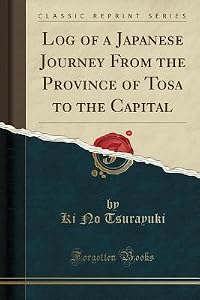
Log of a Japanese Journey from the Province of Tosa to the Capital (Classic Reprint) By Ki no Tsurayuki
The joy found in the Tosa Diary is inherent in being a writer. Every single character visited here has a different reason for writing or composing a poem. Spontaneous expression or planned, to impress someone or to release something. I found it so validating to be reminded that there is no one way to write, ever.
Ki no Tsurayuki 935
Trans in Anthology of Japanese Literature : From the Earliest Era to the Mid-Nineteenth Century.
There is one more genre that blossomed during the cultural flowering of the 10th century_worth mentioning before moving_on: the diary_(nikki), or journal. Diaries had been kept in the_past - factual accounts written mostly by men and in Chinese - but after the appearance of The Tosa Diary around 935, women took over the_genre,_ writing_in Japanese instead of Chinese and borrowing elements from current monogatari to create books that read more like first-person novels than diaries. Although narrated by_a woman, _The Tosa Diary was actually_written by_a man named Ki no Tsurayuki_(872? -945); grieving over the death of his daughter, he apparently_ felt a female persona would better allow him to express his womanly_grief, though he lets the mask slip so many_times nobody_was fooled.2 The Tosa Diary is only a 30page account of the narrator's trip from Tosa (on the island of Shikoku) to the capital in Kyoto, and is apparently historically accurate, but the female persona and the large number of poems inserted in the work blur its genre, resulting in a hybrid of travel journal, uta monogatari, and primer on Japanese verse. (During the trip, the narrator and her fellow passengers write poems, which are freely criticized by the narrator; Tsurayuki wrote the introduction to an important imperial anthology of poetry called the Kokinshu.) This typically_Japanese indifference to genre distinctions is even more apparent in the first major art diary written by a woman, The Gossamer Years (Kagero nikki, 974).2' The author's personal name is unknown, so she's called Michitsuna no Naha: Mother of Michitsuna (her most famous son). Beginning in the third person, she explains why she wrote her book: These times have passed, and there was one who drifted uncertainly through them, scarcely knowing where she was... Yet, as the days went by in monotonous succession, she had occasion to look at the old romances [rnonogatari], and found them masses of the rankest fabrication. Perhaps, she said to herself, even the story of her own dreary 1life, set down in a journal, might be of interest:22 The dreariness of her life stems from being only the second wife of a nobleman named Fujiwara Kaneie and being often neglected him not only in favor of his principal wife but a cornucopia of concubines and courtesans. This diary of a mad housewife is thus rooted in fact but reads like fiction, especially when one learns that Mrs. Michitsuna wildly overdramatized her situation, casting herself as the star of her own soap opera. (As the translator notes in his introduction, For someone in her class to be taken as the second wife of such a well-placed young gentleman as Kaneie would have been considered a fine stroke of luck by most Heian ladies [9].) Although the work has dates like a diary, it is made up of long dramatized narratives that are obviously fictionalized to some extent. But since the author deliberately distanced herself from the old romances, perhaps we shouldn't try to turn her into novelist - she had enough grief in her life. But translator Edwin A. Cranston had no qualms about subtitling The Izumi Shikibu Diary A Romance of the Heian Court, and contemporary critics agree it has more in common with a novel than a diary. The Anais Nin of Nippon, Izumi Shikibu (c. 975-after 1033)_was celebrated_poet with a reputation as a femme fatale. After an affair with one_prince of the realm ended in 1002 with his premature death - and which got Izumi divorced from her husband and disinherited from her father - she begaạn an affair with his half-brother Atsumichi in May_1003 that she dramatized a few years later in a 60-page work that has been called both a ikki and a monogatari. (Its title, like that of nearly every Japanese work I've discussed so far, is a descriptive term used by_later commentators, not the author's choice.)_As translator Cranston points out, its story_conforms to the known facts of this Heian hellion's scandalous life, but: The narration is in the third person, and the point of view is not limited to that proper to a diarist. There are simultaneous or almost simultaneous scenes in different places, imagined conversations, and descriptions of the thoughts and feelings of different people. The work is at least partially one of imaginative fiction. 23 To a reader unacquainted with its history, it sounds like a work of imaginative fiction, beginning with its lyrical opening paragraph. it's obvious this melancholy_baby_is to be numbered with the old monogatari rather than with diary_literature,2s All it lacks is a novelistic title; just as The Sarashina Diary (which I'll discuss later) sounds mach more like a novel (which it is) under its current English title As Crossed a Bridge of Dreams, The Izumi Shikibu Diary should be replaced by something more evocative given the pervasive moon imagery and stylized melancholia, perhaps The Serious Moonlight (with apologies to David Bowie). It remains an open question whether this and the other nikki can be classified as novels, but there is no disputing their enormous influence on the developing Japanese novel. They legitimized introspection, shifted the focus from public events to private matters, and allowed women to join the ranks of authors, still a rarity at this point in history. The first-person psychological novel especially in later Japanese fiction is deeply indebted to the pioneering efforts of these Heian diarists. In the spring of 1009 Izumi Shikibu joined the brilliant court of Empress Shoshi (aka Akiko), which included another lady who wrote a nikki still read today. But she was also putting the finishing touches on a monumental monogatari longer and more ambitious than any previous one and destined to become the greatest novel in Japanese literature.
In her youth, works of romantic fiction had often been more important for Lady Sarashina tha[n] the real world about her; now in Sarashina Nikki she deliberately shaped the events of her actual life into sort of Tale. The modern Japanese genre it most resembles the ever-popular shi-shosetsu or I-novel, in which the author uses the facts of his own life to create a work of quasi-fiction. (14) Paperback I needed this book. I needed its simplicity and honesty, its subtle telling of the story of a pair of parents mourning their daughter, with the backdrop of the Japanese coast. I needed its little humors, its poetry about pine trees and goodbyes and the pain of grief and the coming of the new year and spring.
Beautiful and timeless. This 1912 translation is well worth a read, especially if you are already familiar with the more recent translations by Earl Miner, Helen McCullough and others. Porter's use of rhyme and structure in his renderings of the poetry strays too far into the realm of cultural translation by current standards of translation, but he retains the humor and beauty of each poem, and they are gems in their own right. Paperback The Tosa Nikki (Tosa Diary 土ä½æ—¥è¨˜) , is a poetic diary with the significant literature value. Why?
It is written by a man in a woman's language. I was surprised to learn that Japan discriminated language against women and men, but they did. Woman's language means that he used kana ä»®å and not Kanji æ¼¢å—, the one corresponds to one sound or whole syllable, and the latter corresponds to a meaning (logogram). Kana is easier to learn, while Kanji is more sophisticated, and you need to know old Chinese.
This short poem, written by a man in a woman's language, uses layers of information within the words used. In essence, he plays with the words; therefore, the poem can be read in multiple ways. Of course, that is not my knowledge, but the book contains many footnotes explaining the author's clever wordings.
It is about a 55 days journey by the sea by boat returning home. They make a lot of stops and are full of old traditional Japanese superstitions and religious practices. The woman that supposedly wrote the poem lost a child, so it reminded me of our practice in my country, 40 days of sorrow for the soul of the dead. So perhaps the 55 days journey, the poem has another layer beyond the technical grammatical and wording issues, a more symbolic one on how hard the trip is to forget someone you love. In this case, it is done not with words full of sorrow but proudly as a Japanese will do and purely metaphorically.
I highly recommend this book to anyone who wants to learn Japanese; the footnotes are a bit treasure and give an excellent insight into the richness of their language.
0282383972
Un journal ancien qui nous fait parcourir le Japon en nous dévoilant toute la poésie que peuvent créer des personnes d’horizons différents qui prennent le temps d’observer ce qui les entoure.
Article : https://comaujapon.wordpress.com/2018... The book is about the return journey of a former Japanese Governor in the year 935 A.D. from Tosa to KyÅto, which was the capital of Japan at that time. Due to weather difficulties the journey takes longer than scheduled and the travellers are trying to shorten the time for example with writing poems. Who expects a great plot, will probably be disappointed. Nevertheless, I enjoyed reading this book. I mainly bought it because I liked the concept of ​​a bilingual book. Unfortunately, my Japanese is way too bad to read the original, but just the thought of having the Japanese original in my bookshelf makes me happy. Since even the translation is now more than 100 years old, I had to look up a few words because I didn't know them in English (not my mother tongue). It would certainly also be very interesting to read a more current translation to see whether and how the style would change. The author's explanations at the end of the book were very helpful, especially when it came to the poems, as it allowed puns from the original to be identified in the first place. In general, I thought it was really nice to get an insight into the Heian period of Japan and I was able to learn some things I didn't know about before. 76 The Tosa Diary is the oldest of the Japanese nikki or literary diaries. It is not as accomplished as the pillow book or the kagero nikki since it is lacking their emotional perspective. However it does contain beautiful poetry and a glimpse into time this piece was written (955 AD). Ultimately this is something for insiders and certainly not a key piece of world world literature like the pillow book.
This translation is also over a hundred years old but still vibrant. This edition (a 1970's reprint of the 1912 edition) is okay but more footnotes and a good map would have been welcome. 9780282383978 Second Review:
I found reading the 68-note appendix to accompany each diary entry when the number shows up, number by number, quite useful in terms of some Japanese words, contexts, clarifications, etc. since the added information would lighten our ongoing reading. In other words, compared to my first reading in which I consulted some of them, it was like reading in the texts with fair understanding. However, after reading this entry:
21 MAR. 14th day. -- Rain fell. This day he sent the Capital for a carriage.[65] (p. 103)
and duly consult Note No. 65 as follows:
65
21 MAR. Kuruma here does not mean a jinrikisha, which is a modern innovation of the nineteenth century. (p. 127)
I found it's quite ambiguous leading to a few queries like: How are they related? What is such a modern innovation? (for the sake of those who found the words, 'Kuruma', 'jinrikisha' Greek to them.)
First Review:
Written in 935 by the tenth-century Japanese poet Ki no Tsurayuki, this diary also known as Tosa Nikki (https://en.wikipedia.org/wiki/Tosa_Nikki) has since arguably been dimmed by the more well-known, seemingly widely-read and definitely world famous The Tale of Genji published before 1021. (https://en.wikipedia.org/wiki/The_Tal...) It is interestingly noted on its printing format as a bilingual edition, I think, it should be more beneficial to those readers capable of reading Japanese. In other words, for every two pages I could read only its English translation on the right and, consciously, it's a pity that I found its Japanese original Greek to me on the left. However, as a preamble right before the first entry, it is reverently inspiring to read and ponder on this message:
Oitaru wo, chichi to se-yo. (Japanese proverb)
That which is old should be treated with the respect due to a father. (p. 11)
Classified as diary literature initially published in 1912, each entry contains a narrative and a verse (many entries having a few or none) as we can see from an exemplary extract as follows:
20 FEB. 15th day.--This day no rice and bean gruel was cooked, and, as it was an unlucky day, they crawled slowly along, much to his regret. Today the voyage had already lasted more than twenty days, and they were but as so many days wasted. While all were gazing out to sea, a little girl recited this:
When the breezes drop
Quickly do the waves subside,
When the wind gets up
Then the waves again arise;
Comrade-like they sympathize.
This is, no doubt, hardly worth giving, but it is very appropriate. (p. 49)
As of the five-line tanka poem above, the translator has elegantly rendered into English; the classical tanka meter being limited to 5 lines and 31 syllables (5-7-5-7-7) Moreover, this sentence from him would help the readers read the poems with better understanding and more appreciation, In the translation I have retained the original meter, and introduced a rhyme in the last couplet to emphasize the caesura between the third and fourth lines of the Japanese. (p. 8)
However, there is still something lingering on my mind in that more than once I came across a book similar to this one on display in a branch of Books Kinokuniya in Bangkok; therefore, I would find time to hunt it down to read and compare to see if it is the same title. 9780282383978 Woop! Boat trip from Kochi City to Kyoto! Stopping off at Nahari (奈åŠåˆ©) (Nawa here â€" 奈åŠ), Hane Cape and Muroto! Lots of waka, lots of being sad about a dead daughter they've left behind, lots of it's a bit windy so we're going to stay in port for another week. You can totally see how Japan didn't make it to Australia.
Annoyingly, it has proven impossible for technical reasons to reproduce the sketch of Ki no Tsurayuki's route that appeared in the original edition.
This translation is from 1912, but they have included the Japanese text and we can see the bits they left out! æµ·ã®ç¥žã«æ€–ã¢ã¦ was considered unsuited for translation. But doesn't it just mean Scared of the gods of the sea? Or is it something very raunchy?
Excerpt from Log of a Japanese Journey From the Province of Tosa to the Capital
Officers, both of high and low degree. Indulged so freely in the wine cup, at the feast which he furnished, that all became intoxicated; and, truly, a merry wassail was made on the beach, as the company frolicked here and there in the wildest gaiety.
About the Publisher
Forgotten Books publishes hundreds of thousands of rare and classic books. Find more at www.forgottenbooks.com
This book is a reproduction of an important historical work. Forgotten Books uses state-of-the-art technology to digitally reconstruct the work, preserving the original format whilst repairing imperfections present in the aged copy. In rare cases, an imperfection in the original, such as a blemish or missing page, may be replicated in our edition. We do, however, repair the vast majority of imperfections successfully; any imperfections that remain are intentionally left to preserve the state of such historical works. Log of a Japanese Journey from the Province of Tosa to the Capital (Classic Reprint)
Comments
Post a Comment