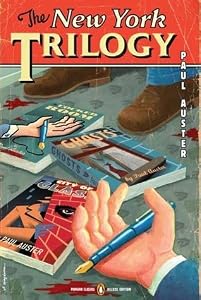
The remarkable, acclaimed series of interconnected detective novels â€" from the author of 4 3 2 1: A Novel
The New York Review of Books has called Paul Auster’s work “one of the most distinctive niches in contemporary literature.†Moving at the breathless pace of a thriller, this uniquely stylized triology of detective novels begins with City of Glass, in which Quinn, a mystery writer, receives an ominous phone call in the middle of the night. He’s drawn into the streets of New York, onto an elusive case that’s more puzzling and more deeply-layered than anything he might have written himself. In Ghosts, Blue, a mentee of Brown, is hired by White to spy on Black from a window on Orange Street. Once Blue starts stalking Black, he finds his subject on a similar mission, as well. In The Locked Room, Fanshawe has disappeared, leaving behind his wife and baby and nothing but a cache of novels, plays, and poems.
This Penguin Classics Deluxe Edition includes an introduction from author and professor Luc Sante, as well as a pulp novel-inspired cover from Art Spiegelman, Pulitzer Prize-winning graphic artist of Maus and In the Shadow of No Towers. The New York Trilogy
Where does it all begin and where does it all end?
But perhaps he would be able to make up for the past by plunging forward. By coming to the end, perhaps he could intuit the beginning.
To seek we must have an object we want to find. To quest we must have a goal we want to achieve. But even if we don’t have an objective we seek and quest anyway because we want to penetrate into the future.
Listen carefully, and perhaps you will learn something. In his little speech to Alice, Humpty Dumpty sketches the future of human hopes and gives the clue to our salvation: to become masters of the words we speak, to make language answer our needs. Humpty Dumpty was a prophet, a man who spoke truths the world was not ready for.
How often pursuing a certain purpose we are on a wild goose chase. And even if we find something how often ot is not a thing we were looking for.
Every tale of the trilogy is an existential quest embarking on which one must find one’s own ego.
There are the watched and there are the watchers and there are those who watch the watchers… The New York Trilogy I have encountered a great many reviews that start with I don't know how to begin this review. By this claim the reviewer expresses doubt, but the expression of these doubts is the immediate solution to the reviewer's predicament, making both the doubts and the claim kind of moot. I was thinking of starting off this review the same way, given that this book leaves you wondering about everything, but thinking about that as an option makes it also dishonest, because I would know where to start with this review. Luckily I found a way around it so ta-da, here we go, smooth sailing, no over-explanation there at all!
This book is a particular kind of great. It's unique in my view, but that's not saying much because my basis for comparison is rather small, so let me elaborate.
The New York Trilogy is comprised of three stories. This is not surprising. It makes sense. This is also the point where the sense stops. That big box of sense you're so comfortable in, all snug and cosy and warm? This book is a bucket of cold water poured all over that adorable situation, making you jump out of the box, into a beautiful realm of wild and wondrous thoughts.
The book starts with the quirky idea of the first story's protagonist being called up by a person looking for Paul Auster. Hmmm, where have I seen that name? Daniel Quinn, a writer, the guy who has picked up the phone, decides to pretend he is in fact Paul Auster, a private investigator. A rather cute idea which is only the beginning of the story, and of a trilogy that becomes a very intricate riddle, with questions of identity and purpose pervading it. The author, the characters, the reader are all embroiled in these stories of stake-outs, shadowing, minicious observations and carefully planned investigations and what starts out as a seemingly cute gimmick of having the author's name as part of the story turns into an adventure you yourself become part of. You as a reader become the investigator. You'll get clues, but without the guarantee you'll get all of them. You'll get answers, but you'll have to find more by yourself.
Paul Auster in bed, reading Paul Auster's novel, The New York Trilogy, in New York City, New York. It's a book by Paul Auster, for Paul Auster, about several Paul Austers, including himself, Paul Auster, author otherwise known for rather austere writings.
This book is immensely readable: the prose employed makes this novel a page-turner, the plot is always intriguing enough to keep one on his toes (understatement of the year). But it's difficult. It's like a Rubic's cube, only without the guarantee that it's actually solvable.
To some readers, this is frustrating. To me, the beauty of this book is that I couldn't solve its mystery, despite convincing myself I have identified some parts of answers and some threads that connect everything. Paul Auster created one of literature's most beautiful riddles. It's a bit of a magic trick and any kind of reveal given to you would ruin it, so I'm not going to scour the Internet for solutions. What I am going to do, is try and solve it upon a re-read, but frankly I think I'll be a bit disappointed if I can.
The only reason I didn't give this five stars is because of the slight headache it gave me. This was probably a bit self-inflicted. I always want everything to fit. This book is like a puzzle box, but the pieces inside are from several different puzzles, none of them matching the picture on the box, and none of the puzzle-sets being complete. I tried stomping the pieces together, hence the headache. I'm planning to return to it and see if I can fill in the blanks somehow, this time without stomping on the pieces and without any headaches. I know I'll enjoy it all over again, but probably a bit differently, knowing what I think I know. This riddle-nature of the book is what makes it so unique: uniquely readable, uniquely challenging, uniquely re-readable, uniquely enjoyable. And very recommendable.
All that having been said, I really don't know how to finish this review. 308 Baudelaire cited by Paul Auster in City of Glass: Il me semble que je serais toujours bien là où je ne suis pas. In other words: It seems to me that I will always be happy in the place where I am not. Or, more bluntly: Wherever I am not is the place where I am myself. Or else, taking the bull by the horns: Anywhere out of the world.
It was a wrong number that started it, the telephone ringing three times in the dead of night, and the voice on the other end asking for someone he was not....
3.5 leaning towards 4... ah, my hate-love relationship with Paul Auster...
I loved some of Auster's books, Brooklyn Follies, Book of Illusions.... but he always keeps me wondering. Like his 'Man in the Dark'. This NY Trilogy (City of Glass, Ghosts and The Locked Room)... it's a crime noire novel... and it keeps you wondering what's going on. I read ShovelMoney1's review who says, 'a study on the watched and the watcher in a sort of claustrophobic ever decreasing circles format'. Good description. Auster's writing is rather pretentious at times, sort of bothers me, but it is also poetic, mysterious and that is where he draws me in....
City of Glass was a difficult start for me, had trouble getting through, including the rather pretentious pages of theories... I read some reviews here of City of Glass which were rather aggressively negative. Putting it mildly. I even considered stopping after that first one, but decided to read on and then the book got to me.... although I'm still thinking how much I liked it and what the h*** does Auster mean with those three stories that seem to make a full circle...
Read it again maybe? Mmmmmm.... maybe. For now, Auster did get into my head, yet again.
'In three variants on the classic detective story, Paul Auster makes the well-traversed terrain of New York city his own, as it becomes a strange, compelling landscape in which identities merge or fade and questions serve only to further obscure the truth.'
I stayed on in the house for a few more days. My plan was to do nothing for as long as I could, to rest up. I was exhausted, and I need a chance to regroup before going back to Paris. A day or two went by. I walked through the fields, visited the woods, sat out in the sun reading French translations of American detective novels. It should have been the perfect cure: holing up in the middle of nowhere, letting my mind float free. But none of it really helped. The house wouldn't make room for me, and by the third day, I sensed that I was no longer alone, that I could never be alone in that place. Fanshawe was there, and no matter how hard I tried not to think of him, I couldn't escape. This was unexpected, galling. Now that I had stopped looking for him, he was more present to me than ever before. The whole process had been reversed. After all these months of trying to find him, I felt as though I was the one who had been found... Paul Auster Σε αυτή την Ï„Ïιλογία θα άλλαζα τίτλο. Θα την ονόμαζα
Έτσι ειναι η ζωή και Î±Ï†Î¿Ï ÎµÎ¹Î½Î±Î¹ Îτσι,μποÏεί να γίνει και κάπως ετσι και αλλιώς και διαφοÏετική και πάλι ίδια και ξανά αλλιώτικη.
Î"εν είμαι σίγουÏη τι να γÏάψω για αυτό το βιβλίο. Î"εν θα ήθελα να μπω σε στεÏεότυπα και κοινά λόγια. Άλλωστε αυτός ειναι και ο σκοπός του βιβλίου, δεν χωÏάει σε πλαίσια,σε συνηθισμÎνες πλοκÎÏ‚ με αÏχή-μÎση-Ï„Îλος. Î'ποτελεί απο μονο τουείδος,υπηÏετεί δικοÏÏ‚ του κανόνες ÏεαλισμοÏ,ωμότητας,φαντασίας και ισως αυτογνωσίας ή απελπισμÎνης Ï€Ïοσπάθειας Ï€Ïος την αυτογνωσία.
Και στις Ï„Ïεις ιστοÏίες ο συγγÏαφÎας ειναι οι ήÏωες του και οι ήÏωες του -δλδ ο ίδιος- ειναι υπάÏξεις που ζουν, εξελίσσονται,μεταλλάσσονται, ψάχνονται,διαμοÏφώνονται μπεÏδεÏονται και κÏατοÏν σημε��ώσεις σε Îνα Ï…Ï€ÎÏοχο κόκκινο σπιÏάλ σημειωματάÏιο.(Îνα Ï„Îτοιο Ï€ÏÎπει να πάÏουμε όλοι θαÏÏÏŽ).
Î'Ï…Ï„ÎÏ‚ λοιπόν οι υπάÏξεις Ï€ÏοσπαθοÏν με αυτοθυσία να μην παÏεκκλίνουν απο τους Ï€ÏαγματικοÏÏ‚ τους εαυτοÏÏ‚ οι οποίοι-όπως και ο συγγÏαφÎας-δεν Ï€ÏÎπει να χάσουν την αλήθεια τους μÎσα στο ψÎμμα που δημιουÏγοÏν οι ίδιοι ανάμεσα σε αυτόν τον κόσμο και τον κόσμο της φαντασίας. Î"εν Ï€ÏÎπει να χαθοÏν,δεν Ï€ÏÎπει να χάσουν το νόημα. Î'ΠΟΤΕΛΕΣΜÎ': αÏνητικό. Î"εν τα καταφÎÏνουν.
Όλοι αυτοί οι ήÏωες μποÏεί και να είμαστε εμείς οι ίδιοι ή κάποιοι που Ï€ÏοσποιοÏνται πως ειναι εμείς.
[Î'Ï‚ μην Ï„ÏελαθοÏμε άλλο ...]
Κοντολογίς, αν ψάχνεται γιατί και πως καθαÏογÏαμμÎνα και αυτονόητα, αν θÎλετε αναγνωÏίσιμο και συγκεκÏιμÎνο Ï„Ïοπο γÏαφής με αναλÏσεις και μυθιστοÏηματική πλοκ�� και ως εκ τοÏτου Îνα καποιο Ï„Îλος, ΜΗΠτο διαβάσετε.
Î'υτή βεβαίως κατα την γνώμη μου ειναι και η μαγεία του συγγÏαφÎα. Î'Ï€ÎÏιττη,ανεπιτήδευτη, χαοτική. Μια μαγεία που σε παÏασÏÏει σε άλλη Ï€Ïαγματικότητα σε διττή και συμβολική ομοÏφιά με μια απογοητευτική κοσμοθεωÏία.
Καλή ανάγνωση;
ΠολλοÏÏ‚ ασπασμοÏÏ‚!!
* Με συγκλόνισε ο μονόλογος του γιου Î Î¯Ï„ÎµÏ Î£Ï„Î¹Î»Î¼Î±Î½. English Ma quanto è bello pedinare (e essere pedinati) da Paul Auster?
https://www.youtube.com/watch?v=_OMZY... Paperback
First, a brief harangue. I can't help but noticing how often the word pretentious has been thrown around in the reviews for this book. What a bothersome word: pretentious. It's a lot like the word boring, in that they both seem to fool the user into thinking that they mean something objective, when in fact they're highly subjective. Nothing is inherently boring, just as nothing is inherently pretentious. On the contrary, these words say a lot more about the speaker than they do about the thing they're supposedly describing.
What does it mean, then, when someone calls a book pretentious? Let's dissect it. What they really seem to be saying is this: I didn't find meaning in this book, therefore anyone who claims to have found meaning is not telling the truth. And this boils down to the following syllogism: I am an intelligent reader; therefore anyone who is also an intelligent reader will share my opinion of this book; anyone who doesn't share my opinion, therefore, isn't an intelligent reader. A valid inference, no doubt, but hardly sound. This is because the whole argument hinges on one unavoidable fact: that by using the word pretentious, one is implicitly assuming that they themselves are intelligent. And everyone knows that only dumb people think they're smart.
So hate on Paul Auster all you want. Say that you found his plots predictable; say that you found his characters unsympathetic; say whatever the fuck you want. But don't call his writingâ€"or his fansâ€"pretentious. Because that's just being lazy. And beyond that, it only makes you sound pretentious.
City of Glass: *****
Speaking of coincidences:
I have this loose policy that whenever I'm reading a book of fiction, I also read something non-fiction; and in this particular instance, City of Glass was counterbalanced by David Hofstadter’s Gödel, Escher, Bach.
Now, it is not my aim to create a sort of synchronicity between any two books I have on the go at any certain time. In this case, my non-fiction choice was based solely on the fact that the book was immediately available.
And yet, I was surprised by a number of similarities that arose between the two. First, both books explicitly mention the Tower of Babel (in fact, if you have a copy of the Penguin Deluxe Classics edition of the trilogy, they both even display artistic renderings of it). Both books also focus extensively on languageâ€"in particular, its relation to reality. But perhaps most importantly, both explore the notion of systems (mathematical, artistic, etc.), as well as what it means to operate outside of said system.
For Hofstadter, this means the ability to interpret a system in a way that isn't explicitly contained within that system, which is a crucial tool for any mathematician (or more specifically, any meta-mathematician). And it's a crucial tool for Paul Auster the writer too. In City of Glass, he creates a strange loop (Hofstadter's term) between the world captured by the narrative and the one inhabited by the reader, with no clear line between them: the boundaries between what's real and what's fiction are masterfully blurred.
Reading the novel, you almost begin to suspect that you were meant to be a character, that Auster probably viewed our world as identical (or at least isomorphic) to the one inhabited by Quinn, Stillman, et. al. And if that's not cool enough: by the end of the novel, Auster turns the tables again, and you finish feeling like every symbol of the story has to be reinterpreted, like the entire piece has undergone a semantic shift.
Brainy, deep, fun and highly recommended.
Ghosts: *****
Reviewing these stories without spoiling them is kind of like trying to defuse a bomb: one with a lot of colourful and potentially unnecessary trip-wires. So in order to minimize the risk, I'm going to refrain from talking about any of the specifics of Ghosts, and instead focus on my more general impressions of the novel.
Here we are: I think it might be even better than City of Glass. No wait, that can't be right. Because City of Glass was pretty fucking amazing. Really, I don't know; I was blown away by both. Indeed, it's true that harboured the fear, from the opening few pages, that the second installment of Auster's trilogy would be perhaps a little too cutesy, with the colour-names and all (Blue, a student of Brown, has been hired by White to spy on Black...). But I should have by then been aware that Paul Auster does everything for a reason. Or perhaps more specifically, when he does something for no reason, it's always for a good reason.
Anyways, what I'm excited for now is finding out whether or not The Locked Room keeps up the trend...
The Locked Room: ***** (???)
I forget exactly where, but I believe it's in one of his letters that Plato writes, your best ideas you don't write down (or something to that effect). What he means, I believe, is that truth has a tendency to avoid complete linguistic formalization, that it avoids ever being captured. This conceptâ€"or a similar oneâ€"was at the core of City of Glass. But with The Locked Room, Auster seems to be actually writing it, as opposed to just writing about it.
This is because it's easy to see how things like the character of Fanshawe, his assorted sub-textual works, the locked room, etc. all map onto aspects of the novel itself. And on a more general level, this serves to comment on our notions of self-hood, language and perception(s) of reality. In this way, The New York Trilogy is a philosophy book disguised as a piece of literature. And yet that's not entirely accurate, because it's hardâ€"if not impossibleâ€"to imagine how it's contents could be conveyed in any other form than they are here.
As Auster himself admits, the story found in The Locked Room is merely a facet of a larger one, one that permeates the entire trilogy. With City of Glass, we were taken to the limits of language. The Locked Room performs a similar featâ€"less obviously, but perhaps more significantly. Auster gives us facts and he gives us names. And from these pieces we construct entire characters: Fanshawe, the unnamed narrator, even a Peter Stillman. But what does this mean? Who is Fanshawe? We are made aware, for instance, of a stark disjunction between pre- and post-disappearance Fanshawe. But with what authority can these two men be said to be the same person? And is anyone ever really just one person?
Whenever you read a novelâ€"although perhaps this one more so than mostâ€"you are engaged in a gathering and compiling facts. You are, for all intents and purposes, a detective: picking up clues, discarding others as irrelevant. And from these, you ultimately construct a cohesive narrative, a story. If you disagree with this sentiment, just think to the Peter Stillman who appears near the end of the novel. Who can help but wonder whether or not this is in fact the same Peter Stillman as was contained within the pages of City of Glass? For we, as readers, cannot help but straying from the text, escaping from its finite world. We draw connections, create links. Never is the text a self-contained entity. Ever.
And Auster, it appears, has a keen understanding of this. So the question he seems to be asking is, what is the relationship between fact and fiction? Between name and thing? And when you finish the novel (both The Locked Room and the trilogy as a whole), you come to realize that it (the book) is forcing you to ask the very same thing of itself. 0143039830
“He venido a Nueva York porque es el más desolado de los lugares, el más abyecto. La decrepitud está en todas partes, el desorden es universal. Basta con abrir los ojos para verlo. La gente rota, las cosas rotas, los pensamientos rotos. Toda la ciudad es un montón de basura.â€En una entrevista se ofreció a la consideración del autor una interpretación de “TrilogÃa de Nueva Yorkâ€, esta fue su respuesta:
“Lo que sea que digas probablemente será interesante y tal vez no se aleje demasiado de la verdad, pero no significa que sea consciente de ello cuando escribo. Todo surge de un zumbido inconsciente y realmente no sé lo que estoy haciendo. Si suena bien, lo hago, y si suena mal, lo rompo y empiezo de nuevo. Todo tiene que ver con un estado emocional en el que te encuentras, ciertos tipos de imágenes que te atrapan y se sienten poderosas y convincentes.â€Interpretaciones aparte, ese zumbido inconsciente es lo único que realmente importa, lo tiene que oÃr el autor pero también lo oye el lector cuando entra en ese estado emocional, cuando consigue esa conexión con el texto, que hace tan especial el encuentro con algunos libros. Un zumbido siempre muy personal, pero que en el caso de libros tan abiertos y sugerentes como este lo hacen aún más propio e intransferible. Como dice un personaje en “La habitación cerradaâ€:
“Las historias sólo suceden a quienes son capaces de contarlas… las experiencias sólo se presentaban a quienes eran capaces de tenerlas.â€Yo he tenido la suerte de oÃr el zumbido, de tener una experiencia con “TrilogÃa de Nueva Yorkâ€, tres experiencias, de hecho, distintas y parecidas pues las tres historias vienen a decir cosas muy similares y prácticamente con los mismos elementos. Escritores metidos a detectives y detectives que parecen escritores (no es una novela de detectives, sà de escritores) que en un momento de sus vidas se dan cuenta de que no son ellos quienes las dirigen y se rebelan de la mejor forma que pueden. Personas que dejan de vivir para centrarse en la vida de otros, uno para autodisolverse en otros yoes, otro inocentemente y sin pretenderlo, el último para borrar su influjo.
“Escribir es una actividad solitaria. Se apodera de tu vida. En cierto sentido, un escritor no tiene vida propia. Incluso cuando está ahÃ, no está realmente ahÃ.â€La identidad, el gran tema de Auster, más relevante para alguien como él que en cada libro tiene que desdoblarse en un sinfÃn de personajes ¿Quiénes somos? ¿Podemos estar seguros de lo que creemos que somos? ¿Llegamos a conocernos alguna vez o nos vamos haciendo cada dÃa más opacos? ¿Pudimos ser otra cosa, nuestra vida podrÃa haber discurrido por otros caminos, cómo de distintos podrÃamos haber sido, somos solo fruto del azar? ¿Hasta qué punto podemos rechazar las imposiciones que nos vienen de fuera e imponer nuestra voluntad? ¿Hasta qué punto nuestro propio pasado nos empuja en una dirección?
“En general, las vidas parecen virar bruscamente de una cosa a otra, moverse a empellones y trompicones, serpentear. Una persona va en una dirección, gira abruptamente a mitad de camino, da un rodeo, se detiene, echa a andar de nuevo. Nunca se sabe nada, e inevitablemente llegamos a un sitio completamente diferente de aquel al que querÃamos llegar.â€Pero también hay infinidad de otras cuestiones. No pocas tratan sobre el lenguaje, la relación entre las cosas y las palabras que las nombran, una mÃtica lengua natural, las limitaciones que el lenguaje nos impone… Sobre el escritor y la literatura, sobre el escritor y su oficio, el amor que deben sentir por las palabras, la necesidad que tienen de creer en el poder de los libros, la confusión entre narrador, personaje y autor, la posibilidad o no de retratar la realidad, de representarla, de fijarla, de ser su espejo, la oscuridad como causa y fuente del escritor, la necesidad imperiosa de escribir, la necesidad imperiosa de ser leÃdos, la forma en la que les gustarÃa ser leÃdos… No está la historia en las palabras, sino en la lucha, y…
“… si significa algo o no significa nada no es la historia quien ha de decirloâ€.Sea como sea, la novela es intensa, desconcertante, contradictoria, autodestructiva incluso, y hermosa. Bien puedo hacer mÃas, para cada una de las novelas y para todas en su conjunto, las palabras de uno de sus personajes:
“Todas las palabras me eran conocidas, y sin embargo parecÃan juntadas de un modo extraño, como si su propósito final fuese anularse unas a otras. No se me ocurre ninguna otra manera de expresarlo. Cada frase borraba la frase anterior, cada párrafo hacÃa imposible el siguiente. Es extraño, entonces, que la sensación que sobrevive de ese cuaderno sea de gran lucidez.â€
POSTDATA 0143039830 NULLA È REALE FUORCHÉ IL CASO
Disegno dalla graphic novel â€Città di vetro†di Davide Mazzucchelli (1994).
Nulla è reale fuorché il caso è scritto nel primo romanzo della trilogia, Città di vetro, e mi pare una summa della poetica austeriana.
Il mio primo incontro con Paul Auster è stato circa trent’anni fa (1990) quando Guanda pubblicò La musica del caso (e si da il caso che il “caso†ritorna). Fu subito amore. Amore grande.
La libreria dove mi rifornivo allora non esiste più da tempo, adesso è un Ferrari Store.
Anche il mio amore per Paul Auster adesso non esiste più.
Disegno dalla graphic novel â€Città di vetro†di Davide Mazzucchelli (1994).
Dopo il primo libro cercai altro. Ma altro non c’era.
Avrebbe potuto esserci, ma era fuori catalogo: si trattava proprio di questa trilogia. Fu pubblicata da Rizzoli lo stesso anno della sua prima uscita in US, ma nel 1990 era già fuori catalogo. Ho dovuto aspettare sei anni, finché non è stata ripubblicata da Einaudi.
Se avessi dato il voto quando ho letto il libro sarebbero state sicuramente cinque stelle. Adesso quattro vanno bene.
Nel frattempo ho letto anche una versione graphic novel.
Jim Jarmush recita insieme a Harvey Keitel nel film scritto e diretto da Paula Auster “Blue in the Faceâ€, 1995.
Si chiama trilogia di NY perché sono tre storie, tre romanzi diversi, pubblicati in US separatamente (1985, 1986 e 1987) e poi riediti insieme sempre nel 1987.
Città di vetro, Fantasmi, La stanza chiusa sono i titoli delle tre storie.
E New York è il set di tutte e tre. E probabilmente il vero protagonista, anche se sembra una città non-luogo.
In ogni storia il protagonista è impegnato in una specie di indagine, come se fosse un detective. Ma sono inchieste immerse nell’allucinazione, nel surreale, perfino nell’assurdo, dove tutto è sfocato, sfumato. Ma il senso di mistero e attesa è forte, insistente, serra l’anima. Auster gioca col genere thriller, o forse sarebbe meglio dire col genere giallo, poliziesco, ma è ben altro che gli interessa.
Ancora Harvey Keitel, qui insieme a Mira Sorvino, in “Lulu on the Bridgeâ€, scritto e diretto da Paul Auster, 1998.
È un gioco di incastri e scatole cinesi e specchi e matrioske, dove per esempio, il primo detective è uno scrittore di romanzi polizieschi e un altro personaggio centrale si chiama guarda caso proprio Paul Auster. Che anche nel romanzo è uno scrittore di romanzi, ma invece lo becchiamo che sta scrivendo un saggio su don Quixote, le cui iniziali, D e Q, sono le stesse del protagonista, Daniel Quinn.
Daniel Quinn assume l’identità di Paul Auster. Alla fine Daniel Quinn sparisce, ma lascia un manoscritto dove racconta tutta la vicenda: manoscritto che qualcuno ritrova nella stanza dalla quale Quinn scompare, e che diventa il primo romanzo della trilogia, Città di vetro
Nella seconda storia i personaggi si chiama Blue, Black, Brown, White, senza ancora anteporre il Mr che qualche anno dopo (1992) Tarantino rese celebri col suo fulminante esordio Reservoir Dogs â€" Le iene.
Il terzo e ultimo film scritto e diretto da Paul Auster, “The Inner Life of Martin Frost (2007) Qui i protagonisti: David Thwelis e Irène Jacob.
In generale, ci sono scrittori che diventano investigatori, o viceversa. Si indaga, si cerca, non si trova, e più si procede nell’inchiesta più ci si smarrisce. La città è un labirinto. Si perde l’identità , si assume quella di un altro, ci si sdoppia, il caso (caos?) regna sovrano.
La ricerca dell’identità è una costante, ma altrettanto costante è il mutare dell’identità perché nulla e nessuno è quello che sembra e appare.
È l’intera poetica di Auster per come ho imparato a percepirla, temi che si ritrovano anche nelle sue opere seguenti.
Sono stato un gran fan di Auster. Poi, qualcosa s’è spezzato. Forse una certa ripetitività , che si trasforma in monotonia, e quindi noia. Forse questi personaggi smarriti che si cercano per smarrirsi ancora di più, che perdono i riferimenti e li tolgono anche al lettore, alla fine m’hanno confuso e smarrito.
Fatto sta che mi è sceso l’interesse mentre lui è diventato sempre più intervistato, sempre più fico, sempre più familista, ha cominciato a non perdersi un party, di quelli con intellettuali & modelle…
Disegno dalla graphic novel â€Città di vetro†di Davide Mazzucchelli (1994). Paul Auster Is The NYT three novels-in-one, or a single tome?
Ah, well: That's four Auster novels in a row for me I guess... and, (not) interestingly enough, they were ALL very much alike (Oracle Night, The Glass City, Ghosts, The Locked Room). It's becoming clear that Auster has adopted very interesting themes, such as the transitory nature of fiction and reality; the writer's world manifested in a literal form; & the double... He writes in free-flow and non sequiturs.
Yeah, I will be the first one to admit that almost always his conclusions are not concrete (and they don't have to be) and will even venture to say that with the exclusion of Timbuktu his endings are all incredibly inelegant. But damn if he isn't readable! Even the writer's ego, a quality I deem somewhat lame when personified in literature doesn't bother me. Yeah, Auster is in love with New York, with the writer, & obviously with himself. But doesn't the saying go Write what you KNOW? And Auster, perhaps not really knowing how his novels will EVER end, does do something very admirable: He keeps the reader in a trance, submerging him/her in a world completely constructed from the marriage of the writer's everyday experience and his almost-visceral psyche. Fiction, Memoir (Book 219 from 1001 books) - The New York Trilogy (New York Trilogy #1-3), Paul Auster
The New York Trilogy is a series of novels by Paul Auster. Originally published sequentially as City of Glass (1985), Ghosts (1986) and The Locked Room (1986), it has since been collected into a single volume.
The first story, City of Glass, features a detective-fiction writer become private investigator who descends into madness as he becomes embroiled in a case. It explores layers of identity and reality, from Paul Auster the writer of the novel to the unnamed author who reports the events as reality to Paul Auster the writer, a character in the story, to Paul Auster the detective, who may or may not exist in the novel, to Peter Stillman the younger, to Peter Stillman the elder and, finally, to Daniel Quinn, protagonist. City of Glass has an intertextual relationship with Cervantes' Don Quixote. Not only does the protagonist Daniel Quinn share his initials with the knight, but when Quinn finds Paul Auster the writer, Auster is in the midst of writing an article about the authorship of Don Quixote. Auster calls his article an imaginative reading, and in it he examines possible identities of Cide Hamete Benengeli, the narrator of the Quixote.
The second story, Ghosts, is about a private eye called Blue, trained by Brown, who is investigating a man named Black on Orange Street for a client named White. Blue writes written reports to White who in turn pays him for his work. Blue becomes frustrated and loses himself as he becomes immersed in the life of Black.
The Locked Room is the story of a writer who lacks the creativity to produce fiction. Fanshawe, his childhood friend, has produced creative work, and when he disappears the writer publishes his work and replaces him in his family. The title is a reference to a locked room mystery, a popular form of early detective fiction.
سه گانه نیویورک - پل استر (اÙÙ‚) ادبیات؛ تاریخ نخستین خوانش: اول اکتبر سال 2010میلادی
عنوان: سه گانه نیویورک: سه رمان پست مدرن: شهر٠شیشه ای؛ ارواØØ› اتاق دربسته؛ نویسنده: پل آستر؛ مترجم: شهرزاد لولاچی؛ خجسته کیهان؛ تهران، نشر اÙÙ‚Ø› 1384Ø› در 455ص؛ شابک 9643691578Ø› چاپ دوم 1386Ø› چاپ سوم 1387Ø› چاپ ششم 1392Ø› موضوع: داستانهای نویسندگان ایالات متØده آمریکا - سده 20Ù…
مجموعه ای از سه رمان نویسنده ÛŒ «پست‌ مدرن» «آمریکایی»، «پل استر» است؛ این سه رمان Ú©Ù‡ هر یک داستان جنایی Ùˆ شخصیت‌های داستانی مجزایی از هم دارند، تنها به سبب مکان مشترک، سه گانه را تشکیل داده اند؛ عنوانهای این سه رمان، «شهر شیشه ای»، «ارواØ» Ùˆ «اتاق دربسته» هستند
رمان «شهر شیشه ای» نوشته ÛŒ «پل استر» یکی از رمانهای «سه گانه ÛŒ نیویورک» است؛ در این داستان: «پس از یک تلÙÙ† عجیب در نیمه شب، دانیل کویین نویسنده داستانهای پلیسی درگیر پرونده ای میشود Ú©Ù‡ از تمام کتابهایی Ú©Ù‡ تا به Øال نوشته است پیچیده تر است؛ دانیل Ú©Ù‡ درگیر پرونده استیلمن شده، تا به آنجا پیش میرود Ú©Ù‡ گذشته ÛŒ خویش را Ùراموش، Ùˆ تمام هستی خویش را وق٠نگهبانی از استیلمن میکند؛
نقل نمونه متن: «شب بود؛ روی تخت دراز کشیده بود، به صدای باران بر پنجره گوش میداد Ùˆ سیگار میکشید، در Ùکر بود Ú©Ù‡ باران Ú©ÛŒ بند میآید Ùˆ ØµØ¨Ø Ø¨Ù‡ پیاده روی طولانی خواهد رÙت؛ کتاب باز شده ÛŒ سÙرهای مارکوپولو روی بالش کنارش بود؛ از وقتی Ú©Ù‡ دو Ù‡Ùته پیش آخرین رمان ویلیام ویلسون را تمام کرده بود، وقت گذرانی میکرد؛ راوی Ùˆ کارآگاه داستانش، «ماکس ورک» معمای جنایات Ù…Ùصلی را ØÙ„ کرده، بارها کتک خورده Ùˆ در Ù„Øظه ÛŒ آخر جان سالم به در برده بود، Ùˆ انگار «کوئین» هم از تلاشهای او Øسابی خسته شده بود؛ «ورک» در Ø·ÛŒ سالها به «کوئین» خیلی نزدیک میشد؛ برخلا٠«ویلیام ویلسون» Ú©Ù‡ هنوز نامی بیش نبوده، «ورک» بیش از پیش به Øقیقت نزدیک میشد؛ در شخصیتهای سه گانه ای Ú©Ù‡ «کوئین» پیدا کرده بود، «ویلسونÙ» یاوه گو، «کوئینÙ» آلت دست، Ùˆ «ورک» صدای جانداری بود، Ú©Ù‡ به تمام قضایا معنی میبخشید؛ «ویلسون» Øتی اگر توهم هم بود، Øیات آن دو دیگر را توجیه میکرد.»؛ پایان نقل
رمان «ارواØ» نوشته ÛŒ «پل استر»، دومین رمان کوتاه، از مجموعه ÛŒ سه گانه ÛŒ ایشان است، Ú©Ù‡ بین سالهای 1985میلادی تا سال 1987میلادی منتشر شده است؛ «پل استر» نویسنده ÛŒ پست مدرن «آمریکایی» بار دیگر، ماجرایی پلیسی میآÙریند Ú©Ù‡ در بستر نگاهی ÙلسÙÛŒ تØقق مییابد؛ «استر» موقعیتهای خلاقانه ای را، در روند داستان پیش میگیرد؛ او نه تنها، مشابه دیگر داستانهای کارگاهی-پلیسی، کارآگاه خصوصی را، به عنوان مغز متÙکر Ù…Ø·Ø±Ø Ù†Ù…ÛŒÚ©Ù†Ø¯ تا معمای داستان را کش٠کند، بلکه از آن شخصیتی میآÙریند، Ú©Ù‡ همزمان، باهوش، Ùˆ با درایت است، خود او نیز صرÙا به جزئی از ماجرای معما بدل شده، Ùˆ در آن ØÙ„ میشود Ùˆ اینگونه تراژدی داستان را رقم میزند؛ در این داستان ÙلسÙی؛ با «آبی (کاراگاه خصوصی)» ماهری مواجهیم، Ú©Ù‡ از سوی «سÙید» مامور میشود، شخصی به نام «سیاه» را تØت نظر بگیرد، Ùˆ هر Ù‡Ùته گزارشی از کارهای او تنظیم کند، Ùˆ برای «سÙید» بÙرستد؛ «آبی» در روند ماموریت خود، رÙته رÙته درمییابد با پرونده ای راکد، Ùˆ غیرعادی مواجه است، Ú©Ù‡ در آن هیچ رویدادی رخ نمیدهد؛ «سیاه» هر روز پشت میزش مینشیند، Ùˆ میخواند Ùˆ مینویسد؛ ماهها میگذرند Ùˆ «آبی» آنقدر «سیاه» را زیر نظر گرÙته، Ú©Ù‡ دیگر رÙتارش شبیه او شده، Ùˆ نیازی به مراقبت از او، در خود نمیبیند؛ گزارشها را طبق نظم همیشگی مینویسد، Ùˆ برای «آبی» Ù…ÛŒÙرستد، Ùˆ در ذهنش، خیالپردازیهایی درباره ÛŒ «سیاه» میکند؛ «سÙید» گزارشها را میخواند Ùˆ دستمزد «آبی» را بدون هیچ توضیØØŒ یا صØبتی برایش پست میکند؛
نویسنده در آخرین کتاب از سری «سه گانه نیویورک» خویش، با وارونه کردن داستانهای معمایی، نوع تازه ای از هنر روایت ر�� Ø¢Ùریده است؛ ایشان در رمان «اتاق در بسته»، کنجکاوی خوانشگر اندیشمند خویش را، برمیانگیزد، Ùˆ جستجوی پلیسی، Ùˆ کارآگاهی، برای یاÙتن Øقیقت را به جستجوی نابتر Ùˆ ÙلسÙیتر کاوش در هویت، بدل میسازد؛ «Ùنشاو» ��اپدید شده است، Ùˆ از او همسر، Ùرزند Ùˆ مجموعه ای داستان، Ùˆ شعر نمایشنامه بر جای مانده است؛ اما چرا راوی چنین وسواس آمیز، زندگی «Ùنشاو» صمیمی ترین دوست دوران کودکی خویش را میکاود؟ در «اتاق دربسته»، داستان از زبان اول شخص (نویسنده) روایت میشود؛ «Ùان شاو» Ú©Ù‡ از دوستان قدیمی راوی کتاب است، به Ø´Ú©Ù„ عجیبی ناپدید شده؛ همسر «شاو» Ú©Ù‡ از پیدا شدن او ناامید شده، Ùˆ میپندارد Ú©Ù‡ شوهرش مرده است، از راوی داستان، Ú©Ù‡ او نیز نویسنده است، میخواهد تا دست نوشته ها، Ùˆ آثار بر جای مانده از همسر Ù…Ùقود شده را منتشر کند؛ ادامه ÛŒ آشنایی نویسنده با همسر «ÙÙ† شاو»، به ازدواج آن دو میانجامد، اما با روشن شدن این Øقیقت، Ú©Ù‡ «ÙÙ† شاو» زنده است، داستان مسیر دیگری پیدا میکند؛ راوی تلاش خود را برای یاÙتن ÙˆÛŒ آغاز میکند، Ùˆ در آن مسیر، با زوایای شخصیتی، Ùˆ زندگی او بیشتر آشنا میشود؛ روندی Ú©Ù‡ به یک پایان نسبتا غیرمنتظره میانجامد. در آثار استر، ترکیبی از تÙکرات روانشناختی Ùˆ رگه هایی از پوچ گرایی Ùˆ بدبینی دیده Ù…ÛŒ شود؛ با اینØال ÙˆÛŒ در این زمینه راه اÙراط را نپیموده، Ùˆ خوانشگر با خواندن «اتاق دربسته» دچار آشÙتگی Ùˆ دلزدگی نمیشود، اگرچه ممکن است در بخشهایی از داستان Ùˆ در مواجه با برخی پیچیدگیها اندکی سردرگم شود؛ «اتاق دربسته» داستان سوم سه گانه نیویورک بشمار میآید؛
تاریخ بهنگام رسانی 20/06/1399هجری خورشیدی؛ 21/05/1400هجری خورشیدی؛ ا. شربیانی 9780143039839
Comments
Post a Comment